

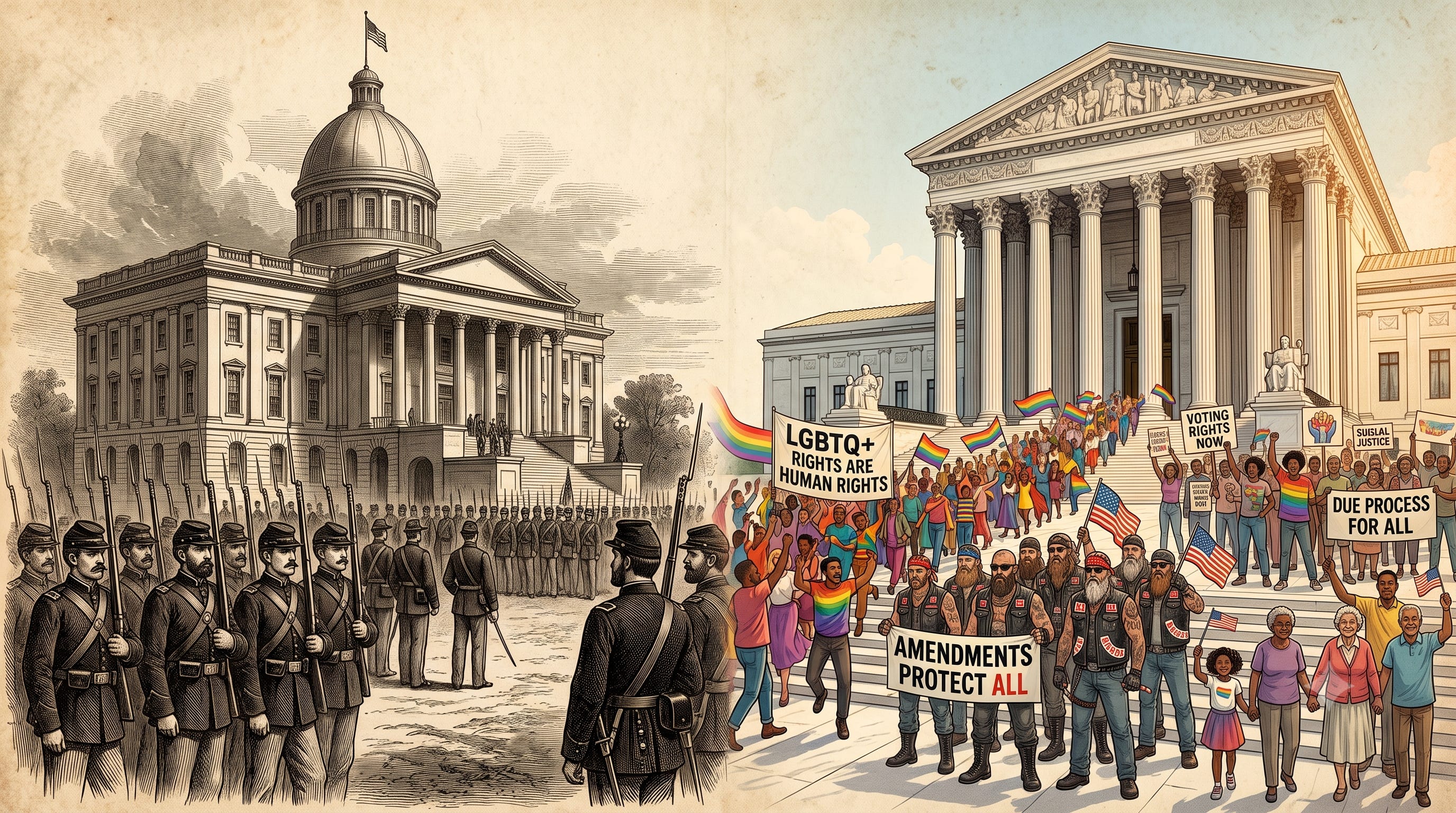
The suits in law collectively known as the Slaughterhouse Cases went to the Supreme Court a hundred and fifty years ago, the first hearing of any legal disputes brought under the Fourteenth Amendment. The amendment consists of five sections, the fifth of which is the enforcement clause. The three preceding it have, until recently, been uncontentious. The opening section, on the other hand, contained such grandiose proclamations about rights and citizenship that it inevitably became what it is today: an endless cornucopia for privilege-seeking plaintiffs and ambitious jurists of the statist persuasion. But in 1873, a mere five years after its ratification, justices still understood that, for all its exalted prose, it had in fact been written with the targeted aim of ensuring that the liberties of former slaves, established in the 1866 Civil Rights Act, could not be revoked by a future majority in Congress — a guarantee secured when Union bayonets in Southern capitals made ratifying the amendment the mandatory price of readmission to the union.
While Slaughterhouse had nothing to do with race, the disgruntled butchers of New Orleans who brought the case invoked the Fourteenth Amendment’s sweeping guarantee of “privileges or immunities,” pleading that Louisiana had deprived them of their fundamental right to pursue a trade when it granted a monopoly franchise to the Crescent City Live-stock Landing and Slaughter-House. By narrowly scoping “privileges or immunities” to distinct national rights — like navigating federal waterways or petitioning Congress — the Court preserved the states’ traditional authority to regulate local health and commerce. Had the plaintiffs proven the monopoly was intended to oppress freedmen based on race, the decision would likely have been different. But in 1873, the justices closest to the amendment’s passage refused to invent a broad federal mandate out of a text written with the limited purpose of securing the rights of former slaves.
In time, however, such narrow construction gave way to far broader theories of selective incorporation and “substantive due process.” These doctrines became the favorite instruments of creative litigators who — by splicing the amendment’s declarations on “due process” and “equal protection” together with preferred passages from elsewhere in the Constitution — discovered “emanations” and “penumbras” of brand-new, federally enforceable rights. Thus, an amendment drafted to address the immediate aftermath of the Civil War evolved into a constitutional Swiss army knife, invoked to justify everything from birth control and employment quotas to presidential elections and gay marriage. Should the Court ever mandate unisex maternity wards or outlaw offensive speech, the Fourteenth Amendment will undoubtedly be the tool that activists use to build their case.
It is strange that advocates who stretch texts to fit their intentions should worry about constitutional justification at all. As long as they’re being arbitrary, why invoke the argumentum ab auctoritate? Perhaps it is because there is something intrinsically human in wanting at least a fig leaf of covering for our naked aggressions. If so, the Fourteenth Amendment has yielded a forest of fig trees for the crusaders of federal expansionism.
In declaring that no state could abridge the privileges or immunities of American citizens, nor deny them equal protection of the laws, the amendment’s framers left those terms largely undefined. While their immediate debates centered on protecting freedmen's basic rights to own property and access the courts, the final text invited far broader interpretation. In time, incorporationists argued that the amendment subjected state governments to the exact same constitutional strictures long imposed on Congress (effectively transforming “Congress shall make no law” into “No government, state or federal, shall make any law”).
It is unlikely that the congressmen and senators who drafted the amendment considered incorporation necessary when states already guaranteed these rights in their own constitutions. Nor is it reasonable to think that the legislators who ratified the amendment—especially in Northern states that had remained loyal to the Union—would have been eager to yield their local sovereignty to a federal judiciary that, just a decade earlier in Dred Scott, had effectively overturned the anti-slavery laws of the free states.
We can also deduce the limited scope of the Fourteenth Amendment from the amendment that immediately followed:
The right of citizens of the United States to vote shall not be denied or abridged by the United States or by any State on account of race, color, or previous condition of servitude.
Under today’s expansive doctrine of incorporation, the Fourteenth Amendment’s guarantees of citizenship and equal protection would surely have encompassed the right to vote. But undercutting that generous interpretation is the fact that a supermajority in the subsequent Congress still felt compelled to pass the Fifteenth Amendment — a multi-state cat-herding procedure requiring three-fourths of the legislatures — simply to establish the suffrage rights of freedmen.
Until recently, only Section 1 has provided any utility for reconstructing this Reconstruction amendment. Today, however, Sections 3 and 4 have been unboxed and deployed to resolve modern political disputes that would have assuredly bewildered the members of the 39th and 40th Congresses who originally imposed these provisions.
For example, Section 3, in 1868, was clearly designed to keep unregenerate Confederates from making any further mischief with the nationalist agenda. The Radical Republicans had a continent to conquer and an industrial empire to build. Keeping the political class of the defeated South out of federal office ensured there would be no more filibustering against the tariff, and no committee room maneuvering against massive land subsidies for northern railroads. And the Senator from Massachusetts was presumably free to deliver his political tirades without fear of getting caned on the Senate floor by the Gentleman from South Carolina. The question of whether states could leave the union having been decided by force of arms, the victor couldn’t afford to admit the representatives it forbade to leave. Hence the section prohibiting anyone who had previously held office from holding further office if they had participated in rebellion.
Section 3 sat undisturbed in the jurisprudential closet for more than a century and a half before being dusted off in 2024 by enterprising litigators in Colorado, Illinois, and Maine in an attempt to strike Donald Trump from primary ballots. According to their interpretation, the former president was disqualified because of his role in instigating the events of January 6, 2021, when a mob rioted at the nation’s Capitol. Speaking at the Ellipse, Trump no doubt incited the crowd with the suggestion that Vice President Pence had the power to reject electoral slates — though he hardly specified by what means an anonymous gaggle of protesters could “peacefully and patriotically” convince him to do so.
But it stretches any reasonable definition of rebellion to equate the bloviating rhetoric and cynical opportunism of Donald Trump with the high-stakes, fatalistic gamble of Jefferson Davis, Alexander Stephens, or Robert E. Lee—men who drew the sword, threw away the scabbard, and wagered their lives and fortunes on a bloody war of secession rather than testing how far political theater could take them. Only a generation so thoroughly insulated from hardship could equate Trump’s political circus with actual, uniformed armies arrayed against the Union. If we were to accept their rationale, then every lawmaker who ever obstructed Congress, objected to electoral certifications, or fled a state legislature to kill a quorum would be equally guilty of insurrection.
Something on the order of a cannonade on Fort Sumter might reasonably justify invoking Section 3. Inciting a crowd to loiter noisily on federal property strays far from its letter. It was little surprise, then, that a unanimous Supreme Court shut down these state-level ballot removals in Trump v. Anderson, declaring that individual states have no business enforcing Section 3 against national candidates without congressional authorization.
On the other hand, keeping one’s political rivals out of power remains entirely true to its spirit.
Section 4 was resurrected during the budget standoff in the spring of 2023. According to that clause of the Fourteenth Amendment:
The validity of the public debt of the United States, authorized by law, including debts incurred for payment of pensions and bounties for services in suppressing insurrection or rebellion, shall not be questioned. But neither the United States nor any State shall assume or pay any debt or obligation incurred in aid of insurrection or rebellion against the United States, or any claim for the loss or emancipation of any slave; but all such debts, obligations and claims shall be held illegal and void.
Having just financed an unprecedented war machine with massive deficits and a flood of paper “greenbacks” to subjugate the Confederacy, Republicans used Section 4 to bind future generations to honor every dime of Union war debt (and all federal debt to follow), while legally repudiating every bond, obligation, and financial instrument issued by the defeated Southern states.
Although extraordinarily partisan, the framers of Section 4 at least respected that the power to run America’s finances into the ground belonged to Congress. Modern invokers of the Public Debt Clause are no less partisan, but hold that the President has a constitutional duty to keep spending whenever the opposing party acquires enough clout in Congress to block a debt-limit increase. Although the so-called “debt ceiling” conveys a sense of fiscal restraint, it is in fact a tissue-thin impediment that Congress has never failed to raise after due hemming and hawing from members assigned the role of budget hawks. The “constitutional crisis” occurs when the hemmers and hawers look to have a real shot at maintaining the current limits against borrowing that has already been authorized. Those who would save us from such a crisis argue that if Congress refuses to raise the debt limit, the President is obliged to declare the ceiling unconstitutional and order the Treasury to keep issuing debt regardless.
As it turned out, Section 4 was reshelved when the theatrical standoff ended in the usual fashion: Congress suspended the $31.4 trillion ceiling, passing the problem to the next Congress while adding another $4.7 trillion to the national debt during the suspension period. Rather than resorting to dubious emergency constitutional provisions, President Biden signed a bipartisan agreement that was made into law and laughably named the Fiscal Responsibility Act of 2023.
Yet the argument remains on standby. Ironically, this scheme to turn a guarantee of post-Civil War solvency into an automatic, self-executing line of credit relies on a literal reading of the Fourteenth Amendment. By asserting that Section 4 creates an executive mandate to issue debt, proponents effectively set the amendment on a collision course with Article I, overriding both Congress’s explicit power to borrow money and its exclusive control over appropriations. If the black-and-white text of the amendment makes non-payment unconstitutional, then elected representatives forfeit their power over the purse whenever spending outpaces revenue.
Decades of elastic constitutional interpretation have already grown the federal Leviathan far beyond its original bounds. Yet the massive expansion to date pales beside the despotic power that could be unlocked by this newfound textual literalism for Section 4.
The context underlying the Debt Clause was one of extraordinary party dominance: the opposition was so utterly prostrate after the war that the Radical Republicans were able to ram through an amendment shielding their fiscal policy from political repeal. Stripped of that context and reduced to mere words on a page, “The validity of the public debt of the United States… shall not be questioned” takes on a terrifying implication. Followed to its absurd logical conclusion, if questioning the debt is forbidden, then criticizing federal spending—funded almost exclusively by debt—is no longer protected by the First Amendment.
While Sections 3 and 4 of the Fourteenth Amendment had to be resurrected decades after the reasons for their existence were dead and buried, the recent battle over birthright citizenship drafted the traditional workhorse of Section 1 for service in a brand-new conflict over policy. Once again, the phrasing intended by the framers specifically to protect newly freed slaves was sufficiently declamatory for inclusion in The Rights of Man and Citizen. “All persons born or naturalized in the United States,” argued the plaintiffs in Trump v. Barbara, makes no distinction of parentage: native or immigrant, invitee or gatecrasher. That invalidates Executive Order 14160, which denies passports and Social Security cards to infants born to mothers residing temporarily or unlawfully in the country. The administration countered that the plaintiffs’ definition omitted the critically restrictive clause, “subject to the jurisdiction thereof,” insisting that mothers who entered unlawfully were properly the subjects of foreign jurisdictions.
The Senate debates of the 39th Congress show that the authors of the Fourteenth Amendment were evenly divided over what “subject to the jurisdiction thereof” actually meant — pitting restrictionists who demanded complete political allegiance against proponents of a broad territorial rule who openly acknowledged it would cover the children of foreigners. They ultimately sent it to the states without any further clarity. Meanwhile, state ratification records provide no support for either side in the immigration debate. During ratification from 1866 to 1868, the precise meaning of those five words was not even discussed. Consumed by the amendment’s more punitive provisions, state legislators accepted without argument the boilerplate text that codified traditional common-law birthright citizenship for Black Americans. The ratifying legislatures gave not a moment’s thought to the exact phrase modern lawyers spend millions fighting over today.
Many subsequent words were spilled, and many trees felled, producing the opinions in Trump v. Barbara—all of them attempting to extract a modern policy position from a document written for a completely different set of circumstances in another century. Rooting its decision in ancient English common law, the majority argued that the framers simply codified the feudal doctrine of territorial jurisdiction—where “jurisdiction” in 1868 meant nothing more than being physically bound by local laws and courts. By that logic, the justices might as well have argued that immigrants warehoused in ICE detention facilities are de facto proof that they are subject to American law.
But this interpretation ignores the congressional statute the Fourteenth Amendment was written to constitutionalize: the Civil Rights Act of 1866, which explicitly restricted birthright citizenship to those “not subject to any foreign power.” The dissent seized on that omission, noting that the American Revolution rejected the British rule of jus soli, where being dropped from the womb onto royal dirt conferred lifelong, involuntary subjecthood. Drawing a direct line from the Civil Rights Act to Section 1, the dissent made a coherent case that “jurisdiction” was not determined by geographical accident, but was a test of political allegiance that temporary visitors and foreign nationals simply cannot satisfy.
It is a charming theory, right up until the moment an “Accidental American” living in London—who hasn’t set foot in the States since infancy—discovers that feudal rules of jus soli still require him to report his foreign income to the IRS. More to the point, to construct this allegiance theory, the dissent had to read “lawful domicile” into an era where federal statutory categories like “unlawful presence,” “visas,” and “illegal alien” literally did not exist.
The fact that Congress submitted the amendment without clear agreement on the limits of citizenship, and that legislatures left no record of debating the subject, underscores that this question was never more than an academic exercise to its authors. After all, in 1868, there was no such concept as an “illegal immigrant.” While other countries were hemorrhaging emigrants to the United States, Americans were welcoming—legally, if not always socially—the tired, poor, and huddled masses. Immigrants arriving in this era expected nothing but the freedom to pursue happiness as they saw fit. Any social welfare aid was provided by churches and earlier waves of migrating countrymen. The government provided nothing beyond unpaved streets, a post office, and the occasional show of force against natives protesting the import of cheaper labor.
While any stowaway reaching American shores could try his luck, the path was brutal. Fully one-third of European immigrants returned to the mother country, where, not coincidentally, European governments were enacting social welfare programs to staunch the ruinous outflow of their labor force.
Unsurprisingly, “allegiance” and “lawful presence” only became pressing constitutional crises once the United States followed suit and built a welfare state of its own. In 1868, when the government offered nothing, a newcomer’s presence cost the public treasury nothing; his allegiance was tested daily by the raw market, and if he failed, he either starved, relied on charity, or bought a ticket home. It was only when American citizenship became the key to a vast network of state-funded benefits, entitlements, and administrative safety nets that the nation began frantically auditing who belonged. We wouldn’t be trying to shoehorn the Fourteenth Amendment into a modern immigration war—indeed, we likely wouldn’t have a case at all—had we not imported the very entitlement programs that made open borders unsustainable in the first place.
The tragicomedy of the modern immigration debate is that Congress’ “immigration policy” rests on an implied power necessary and proper for carrying out its express authority over Naturalization. The Constitution grants Congress the explicit right to determine how a foreigner becomes a citizen, but says precisely nothing about controlling borders, regulating visas, or deporting migrants. If the Fourteenth Amendment is to be forced into serving as the sole arbiter of who belongs, then the only logical absurdity left amid all the conflicting doctrines is to rule that anchor babies are wards of the state and their parents are to be sent home.
Having toured the modern misapplications of Sections 3 and 4, and having had an occasion to witness the tried-and-true Section 1 get redeployed on a new legal battlefront, one might wonder what became of Section 2, written to eliminate the Three-Fifths Clause by reducing the congressional representation of any state that denies or abridges its citizens’ right to vote. Here again, its purpose was aimed specifically to prohibit the vanquished South from undermining the freedman’s franchise, and the clause has yet to be invoked. But given the increasingly ferocious battles over gerrymandering, voter ID laws, and felon exclusions, it is only a matter of time before some inventive barrister in the rights industry argues that “All persons born or naturalized” makes no distinction between model citizen and recidivist, or even between adults and children.
To conclude: none of today’s political problems can be solved by appealing to the Fourteenth Amendment. Whether determining who appears on a presidential ballot, how the United States honors its public debt, or who qualifies for state-funded entitlements, the text offers no easy salvation. While no amendment is more sweeping in its language, none was more narrowly tailored in its true intent. Conceived in revenge and ratified at gunpoint, it was the victor’s terms of surrender dictated as a constitutional amendment, not a timeless charter for administering America’s 21st-century welfare state.