

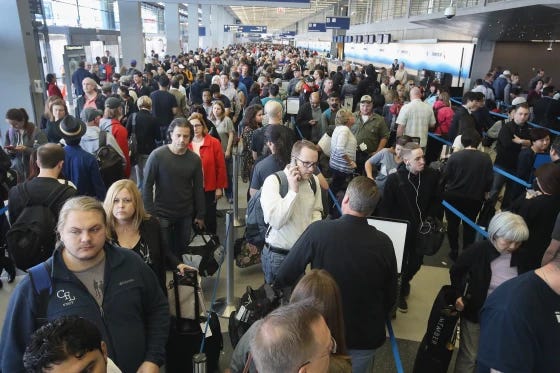
Although the entire world follows the soap opera of American politics, I somehow managed to remain blissfully ignorant of the current “partial government shutdown” until yesterday. Reviewing our travel plans for returning to the United States after seventeen years abroad, we’ve learned that, after a 9-hour flight from Europe and more than a week of waiting to see our dog, we can look forward to an 80% chance of missing our connection and having to stay the night in Chicago.
It seems that agents of the Transportation Security Administration, responsible for fondling old ladies and screening the dainties of the air traveling public in America, are not showing up for work, on account of not being paid, and that they are not being paid on account of the political volleyball that the two parties are playing with the Department of Homeland Security budget.
Believe it or not, fondling and dainties-screening are not at issue. Rather, TSA’s funding is being held hostage to the debate over the funding of a sibling agency. If the Transportation Security Administration reported to the Department of Transportation instead of to the Department of Homeland Security, there’s a good chance we’d only have to put up with the regular inconveniences of flying rather than waiting in long lines due to a shortage of uniformed gropers. But TSA is part of DHS, which is also the parent organization of Immigration and Customs Enforcement, the agency over which the budget battle lines have been drawn.
One side wants to end warrantless raids and the unadjudicated deportations of undocumented immigrants. The other argues that if we don’t halt and reverse the flow of illegal aliens who refuse to enter the country through the front door, we have no way of knowing what diseases and criminality we’re importing. One side accuses the opposition of wanting to flood the voting booths with non-citizens beholden to their political benefactors in the welfare state. The other decries their opponents’ campaign to frighten the nativists into supporting authoritarian measures that will keep them in power.
Each camp presents evidence that confirms their accusations, at least anecdotally. When the next election is likely to reverse the course of any investigation, proving systemic malfeasance is not only difficult; it is also beside the point. The point is counting coup, propagating an eschatological narrative before the cameras, amplifying it through the social media echo chamber, and ultimately corralling the rabble into one of two easily manipulated blocks of voters.
Scrupling over the funding of government agencies allows a politician to look principled while publicly excoriating his adversary for being unreasonable. It doesn’t matter which politician and which mob he is appealing to. The tactics are the same. The mob will get in line and follow his tune. In the zero sum world of modern ochlocracy, preventing the funding of one mob’s phobia is as important as funding the other mob’s rights.
Except, at some point, it all gets funded. Protests simmer down, headlines move elsewhere, and deals are made in private. Until then, travelers across the globe must endure another quarrel in Washington.
Meanwhile, as my wife and I make final preparations to migrate home from the Old World, I call to mind my great-grandfather’s emigration to Michigan. That generation of immigrants was promised nothing. They came anyway, and then they took the jobs of the natives whose services were overpriced. That is the American Way, as American as rioting against the immigrants coming after your job.
It causes me to wonder: If the federal government had no authority to promise anything to any constituency, which way would net migration go? World we still attract the sort who only want a chance to work, save, and provide opportunity for their children? If that is what we want, we certainly have made it more difficult to enter legally than when my great-grandfather came. Or, would the native-born, having grown accustomed to generations of government-sponsored incentives, join the exodus when the government’s money well inevitably runs dry?
I also wonder about the irritating possibility of missing my connection because of people not showing up to do a job I’d just as soon they not do at all.
When I left America, the whole bureaucratic apparatus known as Homeland Security was just maturing, created several years prior after nineteen lunatics with box cutters provoked the largest overreaction in American history (up to that time, at least). On the morning of that late summer day that “changed everything,” there were already bureaucracies and procedures in place when the lunatics slipped through them. In the after action reports, after all the speeches and congressional testimonies had finally concluded, the most useful lessons learned from the attack were the need to A) share information in a more timely manner among the sixteen agencies involved and B) reinforce the cockpit door and keep it locked. (It stands to reason that box cutters can’t endanger a flight if they can’t be applied to the pilot’s throat.)
But to make sure that box cutters never threatened our skies again, over the next ten years we increased our spending on military ordnance and hardware by 50%, adjusted for inflation, as compared to 13.5% percent on everything else. A few generals and admirals warned that expanding our high-tech weaponry would prove ineffective against our likely enemies, but saner voices were overruled in the race to hand out contracts to political donors, jobs to constituents, and capital gains to Wall Street insiders placing their bets on the arms industry.
Of course, terrorists don’t need to terrorize as much among a people that willingly imprisons itself at its own expense. Budgets ballooned for domestic surveillance and security; in fact, they more than doubled the first year after the September 11 attacks. This ushered in a massive consolidation of 22 agencies into the DHS alongside a radical expansion of new federal bodies like the TSA, the Office of Director of National Intelligence and the National Counterterrorism Center, with its 80 “fusion centers” across the country that aggregate state and local law enforcement data into a continental dragnet of information on American citizens. Our borders have become a mesh of fortifications, with a Wall that could serve just as well to keep us in as to keep them out. Even the banking system was pressed into service with tighter reporting obligations and anti-money laundering procedures that require customers to justify transactions with their own deposits.
It would appear that when we crusaded abroad in undeclared wars to “fight the terrorists over there, so we don’t have to fight them over here,” we also turned the might of the state inward on ourselves, militarizing domestic protest responses, expanding warrantless surveillance, restricting our movements, requiring us to explain where we got our money and how we intend to spend it, renditioning suspects to secret camps abroad without habeus corpus or a hint of concern for due process, and subjecting the swarthier among us to show their papers on demand. To add insult to injury, it has all been saddled on the backs of our children’s children to pay for.
Given that the pretext for all this debt, war and diminishment of our freedom was to prevent a repeat of 9/11, we must never forget that one of those planes, United Flight 93 — aimed toward Washington, DC, perhaps toward the White House — never made its destination because the passengers aboard, learning the fate of three other flights that morning, overcame the hijackers and sacrificed themselves to bring the aircraft down before any more innocents were harmed.
What need have we of this Panopticon world we are building in a nation that has such brave and vigilant citizens? What further proof need be offered that a goon with government benefits could not possibly be more conscientious about the safety and security of a flight than the people who are boarding it?
Everyone wants safe flights, including pilots and flight attendants and fleet owners who don’t want to lose inventory, let alone customers (the dead ones are particularly bad for repeat business) -- and lawsuits. If paying customers want pre-boarding security measures, it can be included in the cost of the ticket without the non-flying taxpayer having to subsidize an army of compliance workers, without which the airlines would be forced to compete on safety in addition to routes, comfort, timeliness and price.
Our economy has been so grotesquely distorted by regulators protecting the very businesses they are supposed to be monitoring that we do not see the TSA for what it really is: a collusion of government and the airline industry to outsource the latter’s safety obligations. Profits remain private, but failures and liabilities that would otherwise eat into those profits are treated as a public grievance to be redressed at public expense. And increasing the public expense is the reason d’etre of government.
The two parties differ in how the public’s purse is purloined. Democrats, for the most part, would just expand the bureaucracy. Republicans would hire “private contractors” with government money. Either way, the body scanners at $200 thousand a piece don’t have to be paid for by the airlines that rely on them, and when it’s the taxpayer’s money being spent, no one really cares what the final cost is anyway.
In spite of the multi-generational mortgage we have taken on to pay for our safety, it is difficult to prove one way or another how successful the TSA has been. No one can measure how many lives were not lost because of its existence. Based on an undercover audit of the TSA conducted in 2015, however, we do know that 67 out of 70 testers posing as passengers were let through the security gates carrying prohibited weapons and explosives, a 95.7% rate of failure.
Perhaps the airport screeners were having a bad day, which is bound to happen when your paycheck depends on the demagogues in Congress agreeing to a compromise on immigration policy.